
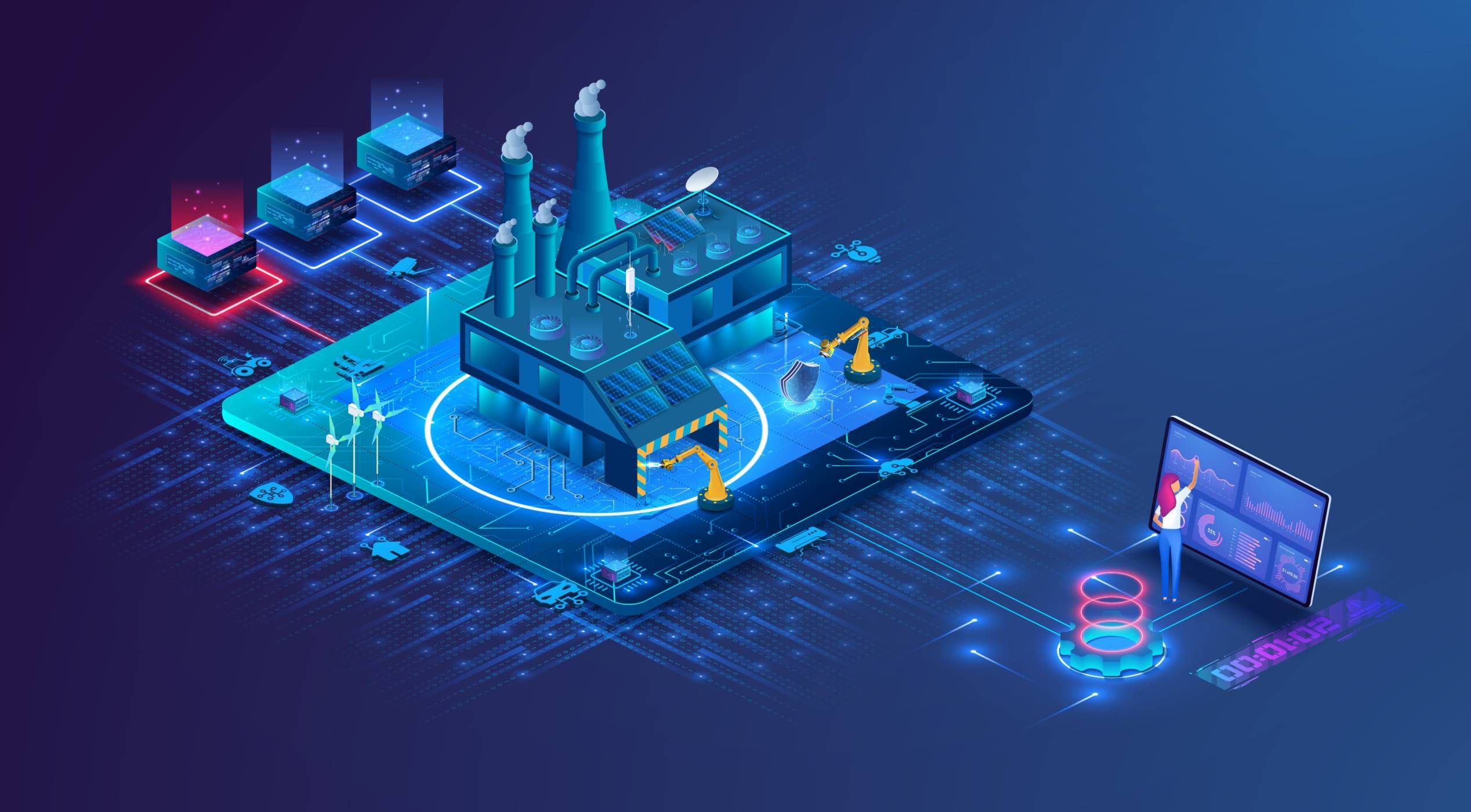
With the ability to boost revenues and cut downtime by as much as 87 per cent, the adoption of digital twin technology continues to grow. While the benefits of digital twins are clear to see, how can we overcome the technology’s limitations? Here, Ross Turnbull, Director of Business Development and Product Engineering at ASIC design company Swindon Silicon Systems, explains how ASICs can help.
If you could experiment freely with no fear of the consequences, what decisions would you make? Digital twins are allowing businesses exactly that freedom. A digital twin is simply a virtual reproduction of the physical world. In the manufacturing context, this could be a digital twin of the shop floor, with every piece of machinery simulated down to the finest detail.
Providing an ideal testing ground for new ideas and processes, digital twins are growing in popularity as manufacturers seek to deliver better products in less time. And use cases of digital twins extend beyond pure manufacturing steps. It’s also possible to create digital twins of the customer or operational environments, allowing for rigorous testing of designs before any investment into physical production.
Constructing digital twins
So how do you go about building a digital twin? In order to collect status data from the components, you’ll need one or more IoT-enabled sensors. Depending on the process and machinery being measured, a variety of sensor types are available.
Accelerometers are a key example. Accelerometers are used to measure the acceleration and therefore the vibration of an object. Since vibration changes are often one of the earliest indicators of a fault, such as a shaft or bearing misalignment, it’s a crucial parameter to observe. The faster any potential issues can be identified, the quicker the machinery can be fixed. Downtime and repair costs are reduced as a result, cutting plant expenditure while driving efficiency and product quality.
Driving implementation
When it comes to digital twin implementation, cost, complexity and compatibility are three of the most common customer concerns. The sheer number of IoT devices needed to provide any benefit to a plant can come at a high price. Machinery advancements and the scale of data being produced means that the processing tasks carried out by the IoT sensors are becoming increasingly complex. And there’s always the concern that the new devices won’t be able to communicate effectively with older, legacy equipment, preventing efficient data collection.
So, how can IoT device manufacturers develop products to overcome these challenges? The answer lies in the electronics. Many sensors collect data in an analogue format, which must then be converted and digitised for transmission across the IoT network. Standard IoT devices may use off-the-shelf ICs to perform these necessary tasks of signal processing and conversion. But there’s a better solution available.
This comes in the shape of an Application Specific IC, or ASIC. An ASIC is a bespoke IC built specifically to fit the customer’s application. And in the case of IoT in a digital twin setting, the choice of an ASIC simply makes sense. ASIC characteristics include compact size, with low power requirements and functionality optimised to the requirements of the product. This makes ASICs the ideal fit for complex, high-volume IoT applications, particularly for battery-operated sensors or those mounted on machinery.
Another key feature, particularly when considering the expected lifetime of industrial machinery, is obsolescence. Production of standard ICs may be halted by the manufacturer at any time. In contrast, custom IC designers will endeavour to minimise the risk of obsolescence. And in the unlikely case it does occur, finding a solution is their priority.
As the potential for digital twins continues to increase, so too does the demand for more sophisticated sensor technologies. Packing the same level of sensitivity and performance into an ever-shrinking device is a challenge. Manufacturers will be pleased to know, however, that they do have options. An ASIC could provide the competitive edge for device manufacturers, while helping end-users unlock the full potential of digital twin technology.


