How Nightsearcher makes them work for you
Hazardous areas are a common phenomenon in many industries. Even though the Oil & Gas industry is especially familiar with explosive atmospheres, hazardous areas are also found in for example woodworking or the pharmaceutical industry.
Plugging in an appliance or flipping a switch on a work light could create a spark sufficient to ignite such a concentration. That is why ATEX, IECEX, and NEC certifications were created—to protect workers, bystanders, property, and infrastructure.
For both suppliers and end-users, it can be difficult to understand the differences between all available certifications, especially when operating internationally. And that is understandable because all certifications are quite similar. So then, what are the differences between ATEX, IECEX and NEC?
The differences between ATEX, IECEx and NEC
ATEX is the shortened form of ATmosphère EXplosibles (from the French for “Explosive Atmospheres”), and this safety standard is used throughout the EU. In actuality it is a harmonisation by the European Parliament and the Council of the European Union in 2014, of many directives from the 27 member countries of the EU, to provide consistency in safety practices.
The IECEX is essentially identical, but instead of just the EU, it is globally recognised. The significant difference lies in the facts that ATEX is regulated and enforced by law whereas IECEX is a harmonised standard. In addition to that IECEx also requires that manufacturers follow the norm more quickly.
Finally, we have NEC (National Electrical Code) Hazardous Area Classification which identifies types of hazards based on the material present. Class I is the presence of sufficient flammable gases/vapours to ignite, with four Groups (A-D) covering everything from acetylene to lacquer solvent vapours.
Class II Covers areas where there are combustible dusts, in three classes (E-G) including electrically conductive dusts, flammable powders (coke, carbon), and non-conductive dusts (grain, sawdust, sugars).
Class III covers powders, dust, or fibres that are generally not present in sufficient quantities to ignite. Division 1 describes locations where these exist continuously, periodically, or intermittently during normal operations. Division 2 refers to areas where they are only present in sufficient quantity to ignite during a machine breakdown or a rupture in the system.
The NEC standards also include two related definitions “Explosion-Proof” and “Intrinsically Safe”. The former means that a switch, device, or system that experiences a condition that could ignite material, it contains that ignition internally and does not allow fire to spread outside of the unit. The latter refers to something which runs on very low energy (voltage/current) and cannot create the conditions for ignition.
Nightsearcher Ltd
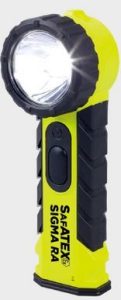 We at Nightsearcher create products that are designed to be safe. No one should “blow up” because they turned on a flashlight or flipped a light switch. This is why we engineered products like the SIGMA RA SafATEX right angled torch. It has an extended run time, up to 13 hours, a powerful smoke piercing beam that penetrates nearly 300 metres, and ruggedized construction, suitable for mines (ATEX Zone 0 gas compliant). It also sports useful features like a clip to mount it on clothing pointing forward, and a large switch that is compatible with heavy gloves.
For a more general purpose area work light, there is the Titan Rechargeable Portable Worklight. This explosion-proof lighting tool is rated for Zone 1, 2, 21, and 22 hazardous areas. It has a run time of 10 hours, produces 1,400-2,100 lumens depending on model at 10 and 15 watts respectively or a high output of 7,380 lumens at 60 watts. It comes with a choice of either a stainless steel stand, or magnetic feet and charges in just 3-5 hours.
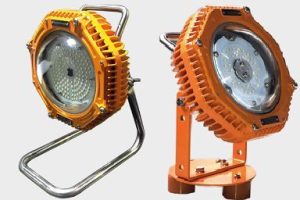 Similarly, for area lighting the Titan AC Hazardous Area Floodlight is intrinsically safe in Zone 2 (Gas) or Zone 22 (Dust). Throwing 17,000 lumens, this SafATEX unit can be found in sewage treatment plants, filling stations, petroleum processing plants, chemical facilities, and manufacturing plants, as well as dockside and offshore installations.
As our final sample of wares, there is the sturdy, steadfast companion search light called the SIGMA SL. This casts a wide area beam at 370 lumens. Equipped with a lithium-ion battery, you can expect up to 30 hours of running time. It is rated gas compliant for zone 0, approved for mining, and its beam can reach 400 metres. 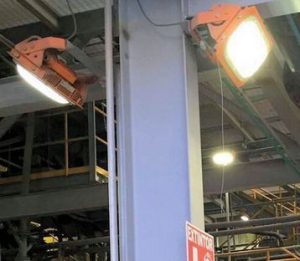 Again, the design is suitable to operate even in heavy gloves with its large accessible switch.
The Takeaway
Good engineering eliminates risk. If you operate in any sort of hazardous atmosphere this is the equipment you need to have on hand. Good quality equipment will protect workers lives, infrastructure, production schedules, bystanders, and you!