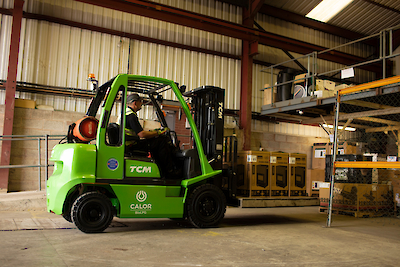
 Switching to low carbon fuels is high on many company agendas at present. However, finding a tangible way to demonstrate the resulting CO2 savings in an auditable manner can be difficult. Andy Kellett, National Account Manager FLTs at Calor, looks at how businesses using sustainable fuels such as bioLPG for their FLT fleet, can access independent verification of these savings.
As many companies, large and small, now have voluntary carbon reduction targets in place, being able to capture all savings accurately and consistently is important, so that all stakeholders can be certain that claims made about carbon savings from the use of this green gas are indeed true.
When reporting using the Greenhouse Gas Protocol for instance, you must use an instrument that meets the Protocol’s quality criteria, as evidence of any renewable energy consumption. External schemes that issue Renewable Gas Guarantees of Origin (RGGOs) and distribute them securely to those purchasing the relevant fuel, is one way to ensure this information is easily accessible and third party verified. It also gives transparency to the manufacture and supply chain from start to finish.
Calor offers a blend of bioLPG and conventional LPG to customers who operate FLTs. Because BioLPG is a renewable fuel made from a blend of waste, residues and sustainably sourced materials, it can bring carbon savings of up to 32% achieved by using a mix of 40% bioLPG and 60% conventional LPG, compared to using conventional LPG alone. To provide certainty of the amount of savings made, Calor works with the Green Gas Certification Scheme (GGCS) to deliver RGGOs to customers who switch to our bioLPG tariff. This partnership provides an objective means of tracking transactions of green gas through the supply chain. Through the scheme, fleet managers can also access certificates of their RGGOs to use when auditing their environmental impact.
To begin the process, the companies producing bioLPG provide an International Sustainability Carbon Certification (ISCC) Proof of Sustainability document that verifies the carbon savings and that the feedstock – used as a base for its BioLPG – is from a sustainable source.
The quantity of bioLPG delivered into the country as part of that particular consignment is then logged by the GGCS, creating a bank of RGGOs available for companies, like Calor, to issue to its green customers on a bioLPG tariff. The system automatically calculates the amount of RGGOs for the customer depending on the volume of gas they receive, and gives the customer access to the GGCS website, from which a recognised certificate detailing the carbon savings can be downloaded.
This smart system ensures certificates and carbon saving calculations are third-party qualified, fully auditable for customers and monitored by the GGCS. Moreover, it guarantees that the RGGOs given for the bioLPG that customers receive has not been double counted or double sold. The process is done automatically and has the added convenience that certificates can be downloaded as and when needed, rather than having to wait for quarterly or half year points.
With visibility of environmental choices so important, opting for a supplier that has a system like this in place means customers can prove their reduction in carbon emissions from day one. As an added benefit, the figures can be audited against environmental targets, so that bioLPG customers can show their own clients, with confidence, that they are taking action on building a more sustainable future.
To find out how Calor can help you reach sustainability targets with bioLPG, visit www.calor.co.uk/flt. To find out more about Green Gas Certification Scheme visit www.greengas.org.uk.