
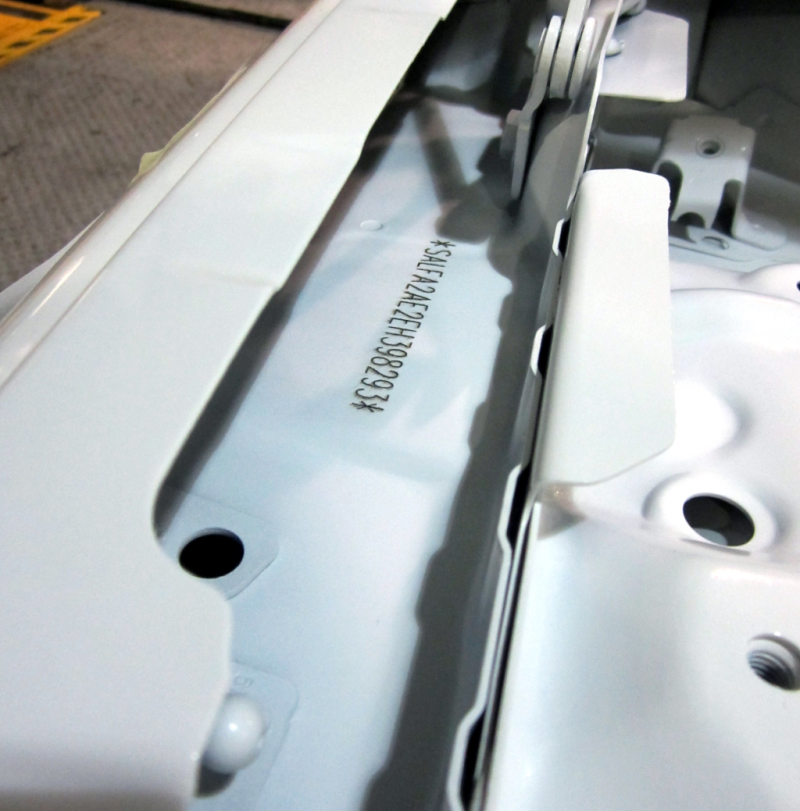
 The Vehicle Identification Number (VIN) is a car’s unique fingerprint. Applying the VIN has always presented challenges to manufacturers, however.
Companies have used various technologies to apply identifying marks. Dot Peen technologies, for example, use an electrically or pneumatically controlled pin to build up the letters from a series of indentations punched into the metal of the vehicle’s structure. The technology is fast, flexible and reliable, but it has several drawbacks for body-marking applications, two of which are significant: noise and cycle time.
The search for a quieter, more operator-friendly approach has encouraged many manufacturers to use a scribe marking technique, in which a hard steel ‘pen’ operating under computer control ‘writes’ the mark into the body panel. Scribe marking is quieter, but it presents other challenges. Scribing requires a lot of force to create a good mark, and that in turn calls for elaborate tooling to clamp the marking head in place and support the panel while marks are made. And that tooling must be custom made for every model in a manufacturer’s range. As carmakers put more models down the same production lines, that means extra cost and complexity. Worse, scribe marking on vehicle body panels can be prone to quality issues, leading to delays, rework and higher scrap rates.
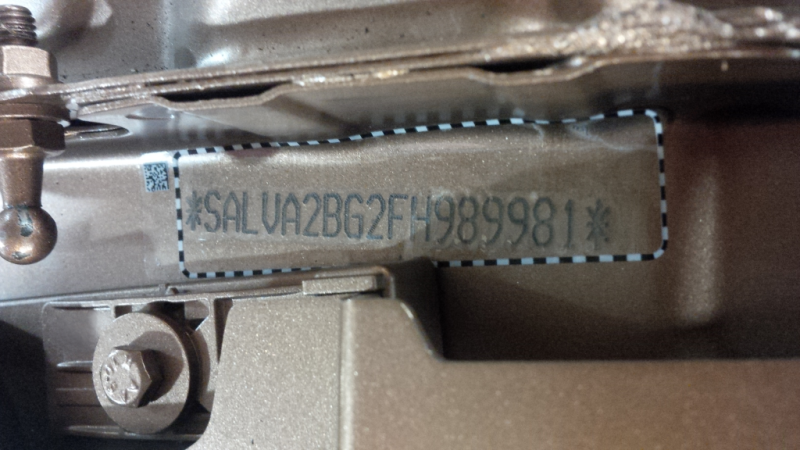 In 2013, production engineers at Jaguar Land Rover were wrestling with all these problems and wondered if laser marking technology might provide a solution, they approached marking and verification specialist Pryor for support.
After looking at the requirements of the task, it quickly became clear to the Pryor team that conventional laser marking technologies would not be up to the task. Jaguar Land Rover’s specification required marks with a depth of 0.5mm, to ensure the VIN was tamper-resistant and would remain readable throughout the life of the vehicle. After much research and experimentation, Pryor developed a high-powered laser system that could be adapted to give a consistent mark of the right depth in very short cycle times.
The next challenge was integrating that technology into the production environment. That required Pryor to apply a host of other smart technologies. By its nature, laser marking is a non-contact process. By mounting the marking head on a robot arm, it would have a system that could seamlessly adjust to suit the requirements of different models, with no need to switch tooling between vehicles, or to build new hardware when future models were introduced. But without a physical connection to the vehicle, ensuring that marks were made in exactly the right place was difficult. A difference in position of just a few mm between one body and the next on the production line could lead to a misplaced, or unreadable, mark.
To overcome the alignment issue, Pryor used its expertise in machine vision to develop a novel solution. A camera, mounted on the robot next to the marking head could be used to locate defining features on the vehicle’s body. Combined with a laser displacement sensor that measured the distance of the panel from the marking head, the vision system could be used to define the precise position of the marking location in 3D space, allowing the robot arm to adjust the position of the marking head accordingly.
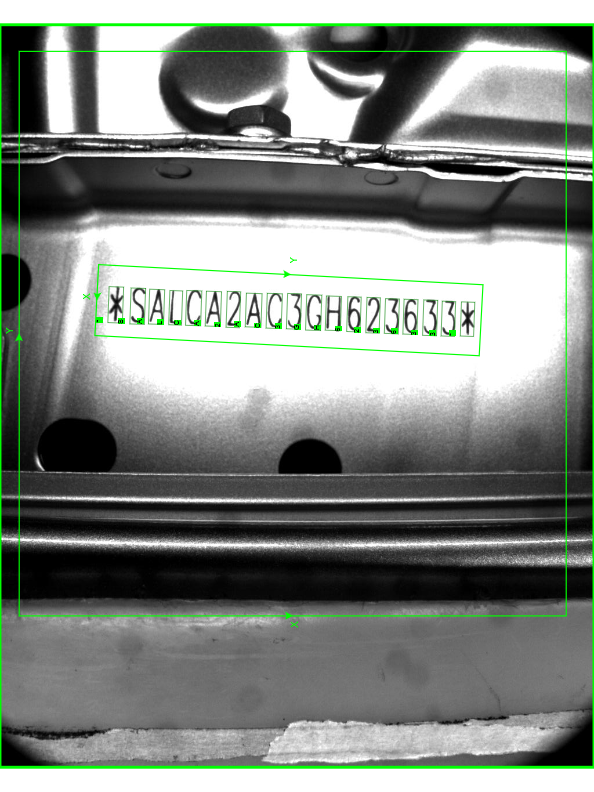 Jaguar Land Rover initially commissioned Pryor to provide marking cells for its plants in Solihull and Halewood, UK. The contract called for two identical cells, with the second acting as a backup to keep production running in the event of a failure in the first.
After the success of the Solihull project, Jaguar Land Rover has commissioned Pryor to install further cells in plant and at its manufacturing facility in China. Those cells use the same basic marking technology, but their layout has been modified to suit the requirements of the individual sites. The design of the Chinese production line, for example, precludes the installation of a separate ‘backup” cell, so a second robot is positioned within the main cell, ready to take over should the first one fail.
For Pryor, the work with Jaguar Land Rover is the next step in a continuous evolution of product marking technologies that stretches back to the middle of the 19th Century. The company has won several industry awards for the work, including The Manufacturer’s Innovation of the Year and the Sheffield City Region’s Manufacturing and Business of the Year awards. “High speed, high power laser marking is a uniquely effective solution for demanding applications in fast moving production environments,” says David Ray, Technical Director at Pryor. “This technology complements our other marking solutions, allowing us to address the widest possible range of industries and application requirements.”
Find out more about the solution at https://www.pryormarking.com/jlr


