
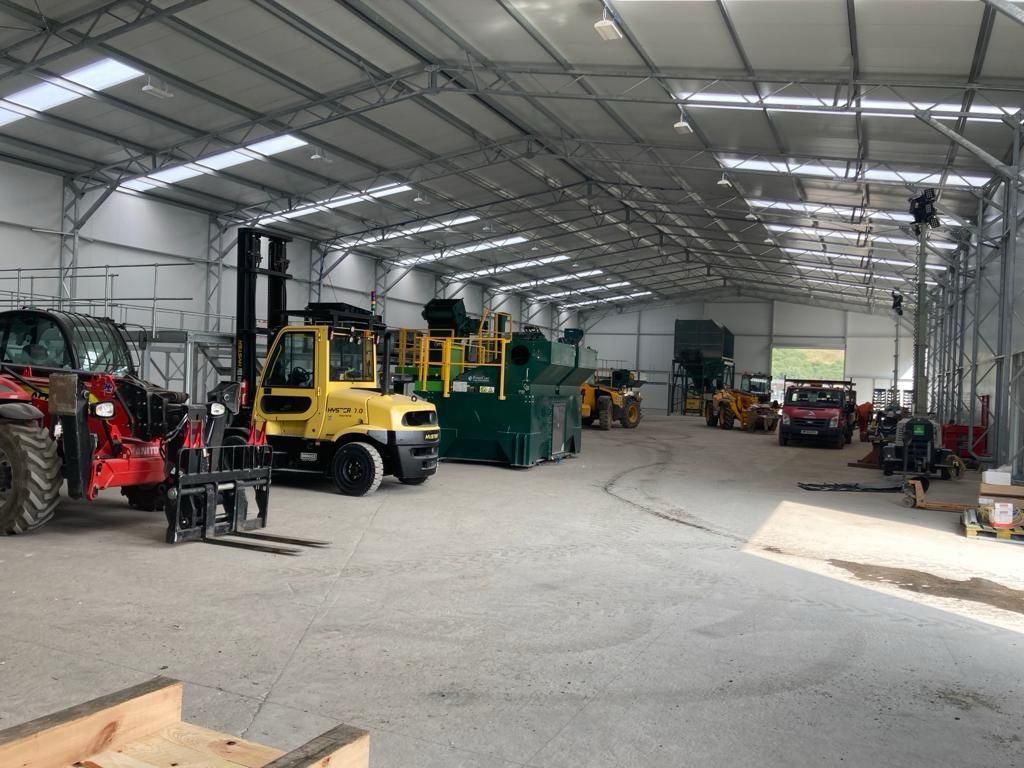
Deciding when to invest in additional space isn’t always straightforward.
Even when existing facilities are stretched, rising operating costs and uncertainty about future demand mean many businesses are more likely to make do with their current premises than commit to a new building.
And although that might seem like a safe option at first, Jason Lynock, Sales Director at Smart-Space, says there’s another side to this decision. While the cost of a new building is relatively easy to calculate, the cost of delaying expansion can be much harder to see.
Extra handling, inefficient processes, missed orders and temporary workarounds all have financial consequences. Individually, these costs may seem manageable, but together, they can make waiting considerably more expensive than expected.
When space starts costing you money
A lack of space doesn’t necessarily stop production; however, it can create small inefficiencies that gradually affect productivity.

For example, raw materials may need to be moved several times before reaching the production line, finished goods might be stored in areas intended for other activities, and forklifts and staff have to work around increasingly congested routes.
None of these problems appears significant in isolation, but each additional movement takes time, uses equipment and adds to operating costs. Because the individual inefficiencies are often barely noticeable, businesses adapt their processes to work around them, letting costs build up without necessarily recognising how much they’re losing.
Businesses may also resort to short-term workarounds, such as ordering in smaller quantities or changing shift patterns, to maintain output when space limits how much work can happen at once. While these changes can provide some immediate relief, they often come at a price, creating problems elsewhere in the operation which lead to further adjustments and disruption as the business tries to make everything fit.
The opportunities you can’t take
Perhaps the biggest cost of insufficient space is the business that never happens.
You may have the machinery, workforce and customer demand to increase production, but if there’s nowhere to store additional raw materials or finished goods, taking on a larger order or a new customer is at best impractical and at worst, impossible.
According to the Manufacturing Technologies Association, 29% of UK manufacturers would be unable to expand their current capacity if asked; while funding constraints were the top reason, lack of space ranked second.
And while the immediate loss might be a single order, the longer-term consequences can be greater. Customers who find another supplier may not return, potentially affecting future business as well as today’s revenue.
Why businesses put off expanding
Of course, there are good reasons why businesses delay investment in additional buildings.
Permanent construction can involve significant capital expenditure, lengthy planning processes, groundworks and disruption to an operational site. Businesses may also be reluctant to commit to a new facility that may be too large, too small, or no longer suitable in a few years when future demand is uncertain.
But delaying permanent construction doesn’t have to mean delaying additional space altogether – there is another option.
Creating space without the long wait
Temporary buildings offer an alternative for businesses that need to increase capacity without committing to a lengthy and expensive construction project.
Depending on the building specification and site details, additional space can be installed within weeks. Many PVC roof structures can be secured directly to suitable existing surfaces, avoiding the need for purpose-built concrete foundations and reducing site preparation.
The financial commitment can also be more manageable. At Smart-Space we offer rental agreements that let you create additional warehousing, production or dispatch space without tying up capital that could be invested elsewhere.
And because future requirements aren’t always predictable, the building can be extended, reconfigured or relocated as the business changes. If the additional space becomes a permanent requirement, you can purchase the building from us at any point during the rental period, with the future purchase price provided upfront.
What is waiting really costing?
There will always be circumstances where delaying expansion is the right decision. But it’s important to understand what that decision is costing and the price of a new building is only one part of the calculation.
Lost productivity, additional operating costs and missed opportunities can have just as much impact on the business, even if they’re not always as easy to measure.
Sometimes the most economical decision isn’t to wait until a permanent building becomes viable, but to find a more flexible way to create the space the business needs now.
For more information, visit www.smart-space.co.uk


