By Andy Billingham MD EMKA (UK) Ltd.
There are many reasons for specifying compression locks and latches – from their anti-vibrational properties to the way they provide a greater depth of pull on the gasket with a more controllable but often greater force so ensuring a better seal than other approaches.
Given that this may involve gasket compression over the range from 2.5 to 20mm (even up to 30mm) and sealing of up to IP65 we can see that it becomes important to match the gasket to the compression latch. With high compression forces and a wide compression range we can expect that an especially resilient gasket will be required. This resilience is a function of material on the one hand and profile design on the other.
Consequently we should seek a material with good compression recovery – fortunately most rubbers used in gasketing are excellent in this regard. For example natural rubber, neoprene and EPDM all perform well in compression set and resilience tests.
The main differentials then become the environmental and chemical considerations of the specific application since however good its initial resilience the incorrect material is likely to deteriorate quickly if used in the wrong place. Our paper on Materials, Properties and Testing of Sealing Profiles offers useful guidance.
Similarly the ability to provide “soft” gasket compression is valuable on cabinets with EMC gasket to ensure a firm contact, or indeed on large door panels where the closure force needs to be distributed over substantial distances or adjusted to allow for manufacturing tolerances.
Regarding the profile section design, we need to look further at the way in which the structure deforms and is able to return to its relaxed position. Our white paper on Structural Aspects of Sealing Profiles gives further information. Clearly the greater the deformation required then the more hollow a section needs to be – but unless we can accept a very wide section and quite low compression forces – then sufficient internal bracing is important to provide positional stability and to maintain integrity of the gasket form when returning to its original shape. The compression of a typical sealing edge protection profile should be a maximum of 50% as otherwise the compression and recovery can be adversely affected. It is recommended the profile should be compressed 30-40%.

 Where it has been chosen to use a compression latch we may infer that a good degree of dust and water protection is required and to that end we will seek to minimise vulnerable areas in the gasket such as butt joins and corner joints or folded corners.
An excellent solution is often the use of spliced joints which can be applied to most profiles using the hot splicing/vulcanising process to chemically bond two ends of a rubber extrusion together, this process effects a reasonably strong and dynamic joint and is particularly effective where there is a requirement for a continuous ring or frame such as windows or automotive applications and is both easier and quicker to install than raw strip. Spliced joints ensure that the resilience and dynamic properties of the profile are maintained throughout the joint thus creating an endless seal.
These EMKA sealing profiles include a large number of stock sections and an extensive custom production capability. Many profiles are available as simple mouldings, but it is also possible to have sections moulded onto spring carriers even in small custom quantities.
Compression latch/lock technology now widely available enables specialist OEMs to “raise their game” on sealing while conferring a high level of vibration resistance – they are also available in stainless steel. An excellent example is the Program 1000 swinghandle style of compression latches which are expected to be of particular value for closure of cabinets/enclosures, especially in air-conditioning or vehicle equipment access situations, as well as other similar applications which require substantial opportunity for adjustment.
EMKA’s 1000 Program of IP65 compression latches now encompasses a full range of lockable T handle, Wingknob, Square key and L handle variants, with shaft extensions to suit unusually deep door frames up to 95mm. They are frequently used in acoustic cabinets, genset installations, refrigeration, HVAC and on-board vehicle situations. This extensible shaft variant provides additional depth capability and also permits manual clamping adjustment by means of a threaded feature at the inner end which enables the compression action to be fine-tuned.
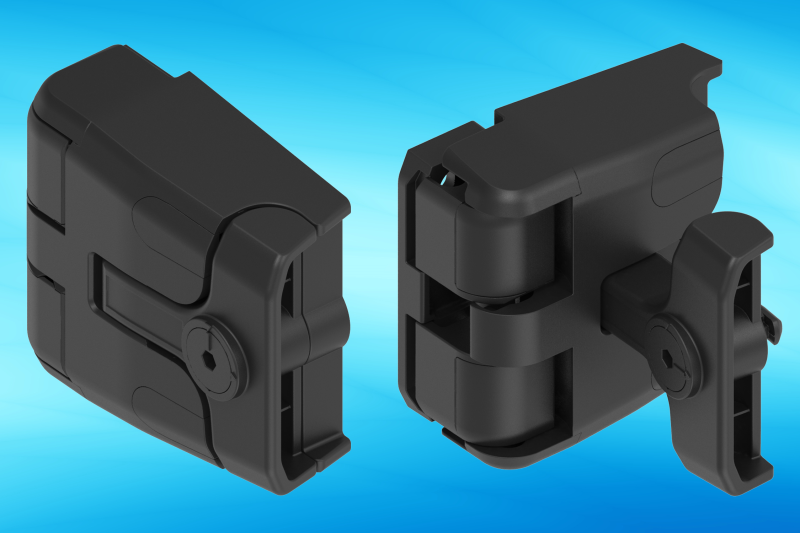
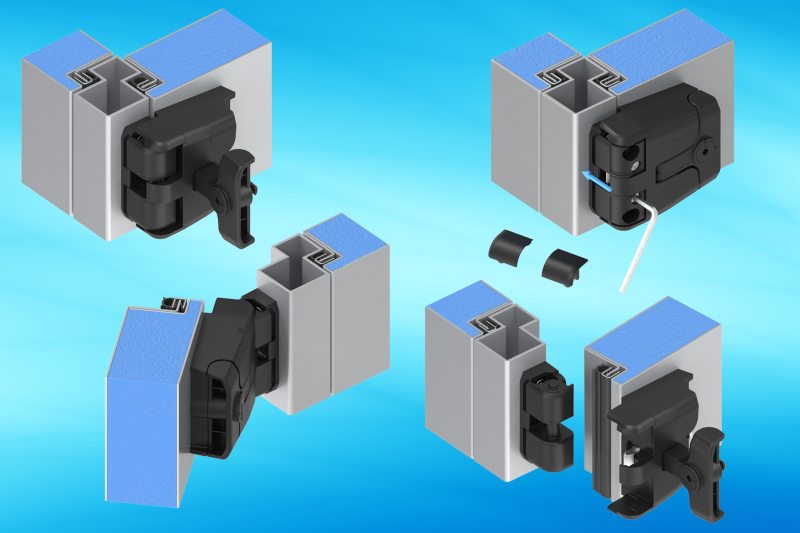 The new HVAC Compression Latch-Hinge is designed to meet the particular demands of the HVAC industry with features that provide ease of assembly, adjustability, pressure differential accommodation, and flexibility for the end user. Once assembled to the door the EMKA compression latch can be adjusted to properly mate to the cabinet by moving both vertically and horizontally. Then after installation the alignment of the latch can be adjusted to eliminate leaks. The latch will then prevent the door from opening fully until pressure has been equalised.
EMKA’s innovative Double Red compression latch handle is especially tailored to the numerous storage boxes in caravans and other specialist vehicles where luggage and safety equipment is stowed. As both opening mechanisms are marked by a red ring visual indicator, the lock is called the Double Red – it is classified shock proof and vibration proof, as well as offering IP65 protection.