 LEAN manufacturing originates from the Japanese automotive industry when just after World War II, Japanese factory owners adopted a number of American production and quality techniques. It has evolved over the years into a holistic system for both the manufacturing and services sectors and aims to address process flows and waste issues, particularly in a factory environment.
LEAN training has become increasingly popular in today’s world as companies focus on keeping their costs down while, at the same time, increase their productivity. Operational efficiency is at the heart of this dilemma and this is exactly where LEAN training can help any company, large or small.
Neil Fedden, Owner & Managing Consultant of LEAN Business Specialists, Fedden USP, explains the concept of LEAN business training: “Our LEAN training workshops help to deliver real and sustainable business benefits by improving process efficiencies, reducing lead times, removing wasted activities and improving problem solving capabilities. Once embedded into a company, LEAN training techniques will bolster a company’s bottom line as it’s not unusual for companies to see potential savings of £50,000 p.a. resulting from a LEAN training workshop.”
There are a range of LEAN training workshops available depending on what area of your business needs to be improved, but one of the most popular LEAN workshops delivered by Fedden USP in conjunction with MIT Skills, is the LEAN Business Improvement Techniques Adult Apprenticeship programme.
This Lean BITs Level 2 programme consists of six days of training followed by 12 months project support and covers an introduction to LEAN, before going on to teach companies how to implement LEAN techniques in their particular business as it will be different from one company to another. Some of the key topics covered include:
- Principles of LEAN Operations – how to differentiate between which activities add value and which ones are classified as waste. Many companies undertake activities because they have always undertaken these activities, they are historic, but they have never stopped to question why or to assess if the activities are beneficial to the overall success of the business.
- Process Flow Analysis and Process Mapping – focused on improving productivity by showing operational teams how to identify the steps involved within a task, and how to simplify the activity to eliminate or reduce waste within the process. The following is a good example:
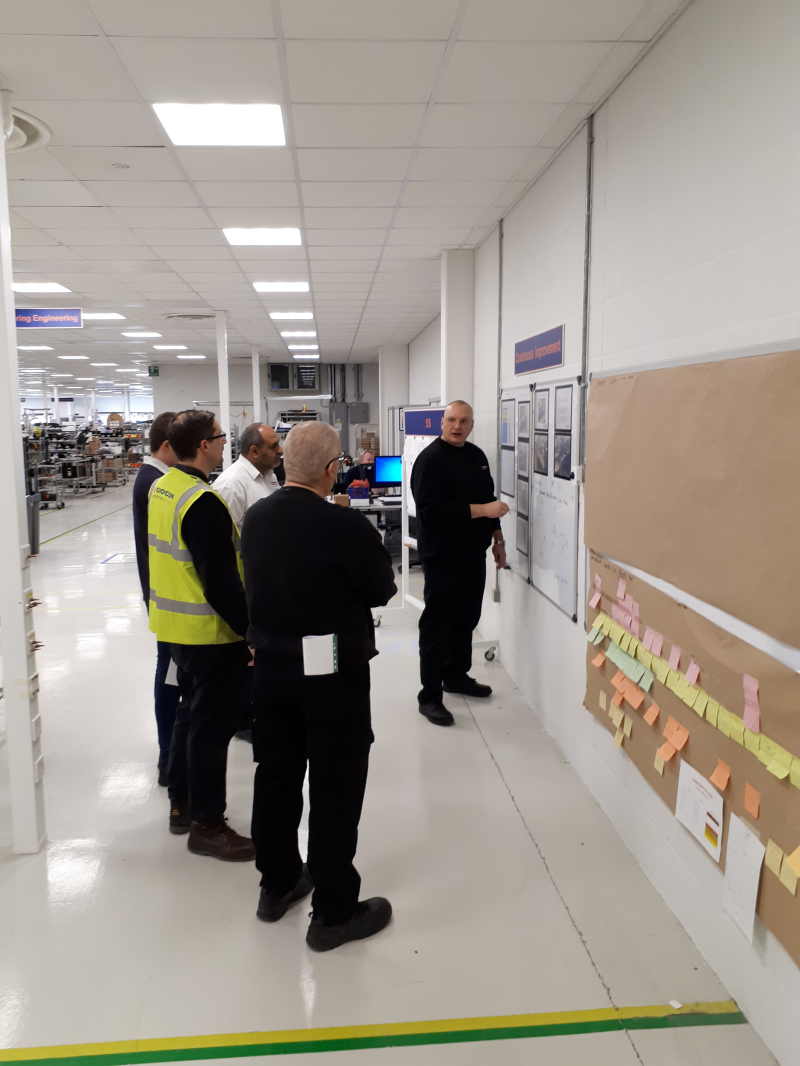 A project at Crowcon Detection Instruments in Oxfordshire required the team to utilise tools such as Waste Walks, Process Mapping and Standard Timings to develop a Current State Process Map. Production Manager, Mark Guest coached the team and explains: “The teams are taught how to identify waste, with games used to teach them about the benefits of ‘flow’ vs. traditional ‘Batch and Queue’. They review the Current State and identify steps that add no value, which can therefore be removed. A Future State process is then created that ‘flows’ instead of batching and this can lead to significant improvements. By applying these tools, Crowcon achieved a 48% increase in capacity on one manual assembly line. A second project also yielded a volume uplift of 41% on another manual assembly process, without any alteration to the manning of the line”.
- Effective improvement teams. This is particularly important in Process Mapping, as impressive results have been achieved by creating a multi-disciplinary team (e.g. supply chain, design, service engineers, etc.) who all bring different perspectives on what can be done to improve a process.
- 5S and Workplace Organisation Techniques. The organisation of equipment and materials to minimise the movement of operational staff can lead to typical productivity improvements of 15% and reduce cash tied-up in stock levels. 5S is a structured way of tidying up operational areas and more importantly maintaining discipline to keep it that way so it becomes the norm!
- Staff-led Continuous Improvement Techniques. This ensures that the improvements achieved are not only sustainable, but members of staff are equipped to identify future improvements. This is the cultural change that will ensure that organisations continue to evolve and stay ahead of the competition.
 The LEAN training workshop benefits both the company and the delegates as it provides delegates with an opportunity to gain a nationally recognised qualification by identifying a specific tangible improvement for their own business, which has been approved and implemented by the company concerned over a 12-month period, with mentoring support from Fedden USP. Both the qualification and the training can be funded from the Apprenticeship Levy introduced by the Government in April 2017.
A company will achieve a long-term benefit as more employees are trained in LEAN tools and techniques. The LEAN principles become embedded into the culture of a company and more and more ideas for continuous improvement are generated. The result is that, over time, employees become more engaged in the company as they drive their own ideas forward and this will inevitably result in an increase in the company’s bottom line.
If you would like further details about the LEAN Training workshops available from Fedden USP, please contact Neil Fedden at neil@fedden-usp.co.uk, or call Neil on 07899 971183.