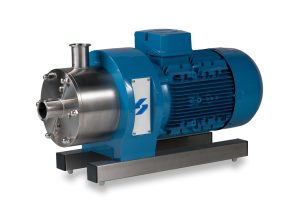
 Silverson Machines has recently released two new animations in their Silverson Mixing Science series on specifying Mechanical Shaft Seals and Thermosyphon Sealant Systems for In-Line mixers. In these animations Silverson explains when and where each type of seal or sealant system is beneficial when mixing In-Line.
Specifying Mechanical Shaft Seals
In this animation, Silverson explains why some applications require single mechanical shaft seals, and why others require double mechanical seals on In-Line mixers.
The mechanical shaft seal contains the mix in the body of the In-Line mixer where the rotating shaft passes through the body. For many applications, a single mechanical shaft seal is all that is required to prevent liquid from leaking out of the mixing chamber.
But if you are mixing materials that are abrasive or sticky in nature this can cause problems where a single mechanical seal is being used. Abrasive materials cause the seal faces to wear, and sticky substances can solidify between the seal faces when the mixer is switched off; this can cause the seal rings to seize and break when the mixer is restarted. To avoid this a double mechanical seal would be recommended.
 A double mechanical shaft seal can be two single mechanical seals mounted in a chamber, or a cartridge seal. The chamber between the seals needs to be flushed with sealant fluid which is compatible with the product being mixed and preferably non-flammable. The pressure inside the double seal chamber must be higher than that inside the mixer. This forces clean, lubricating liquid between the seal faces to cool and lubricate them and prevents any of the product from inside the mixer from getting onto the inboard seal faces.
Thermosyphon Sealant Systems
If you are flushing the double seals with liquid other than mains water, for example if you are using oil or glycerine, this is where a Thermosyphon system is often required.
The application and use of thermosyphon systems is explained in the latest Mixing Science animation. But to summarise, sealant fluid is recirculated from a chamber mounted above the mixer. This fluid flows down to the seal where it cools and lubricates the seal faces. As it heats up due to friction it then rises upwards from the seal outlet back to the sealant chamber. This displaces the cooler fluid in the chamber which then flows down to the mixer, continuing the circulation of fluid through the system.
Silverson High Shear In-Line Mixers
 Both of these new animations regarding the selection of seals and sealant systems relate to their use with a Silverson High Shear In-Line mixer. Seals and sealant systems for in-tank Batch mixers are available but they are highly specialised and are not covered in these animations.
When mixing continuously in larger batches, In-Line mixing is often the method chosen by manufacturers to get the best results; it also offers greater energy efficiency over in-tank mixers as the mixer’s effort is concentrated on a small volume in the mixing chamber rather than having to circulate the entire volume in the tank.
One of the most versatile mixers on the market, high shear rotor/stator In-Line mixers have the ability to form stable emulsions, de-agglomerate, reduce particle and droplet sizes and blend powdered and liquid ingredients. These self-pumping mixers consist of a high-speed rotor turning with close clearance inside a fixed stator. This workhead is impossible to bypass so all material is subjected to high shear as it passes through the workhead. Silverson’s standard In-Line mixers have flow rates of up to 200,000 litres per hour. This rate may reduce as viscosity increases, but Silverson also offers a High Viscosity In-Line mixer with a special ‘pumping’ rotor for processing higher viscosity applications. The HV In-Line does not require an additional feed pump and can process products such as Mayonnaise and gels and creams. Rotor/stator In-Line mixers can generally achieve a particle or droplet size in the range of 2 – 5 microns, or finer depending on the ingredient type and formulation.
 Specifying and using the correct seals and sealant systems for your application is important; it not only ensures the mixer continues manufacturing in good working order for a longer period of time, it helps to reduce downtime for maintenance and the cost of repairs where seals of the wrong type are incorrectly used.
To watch the new animations, or to find out more about Silverson In-Line mixers, please visit the Silverson website: www.silverson.co.uk. Or for guidance with selection of sealing systems for your application, contact Silverson.