… and greater application scope through wider field of view
Quite simply the new FLIR i-Series has no equal. No other thermal imaging cameras within this price bracket have t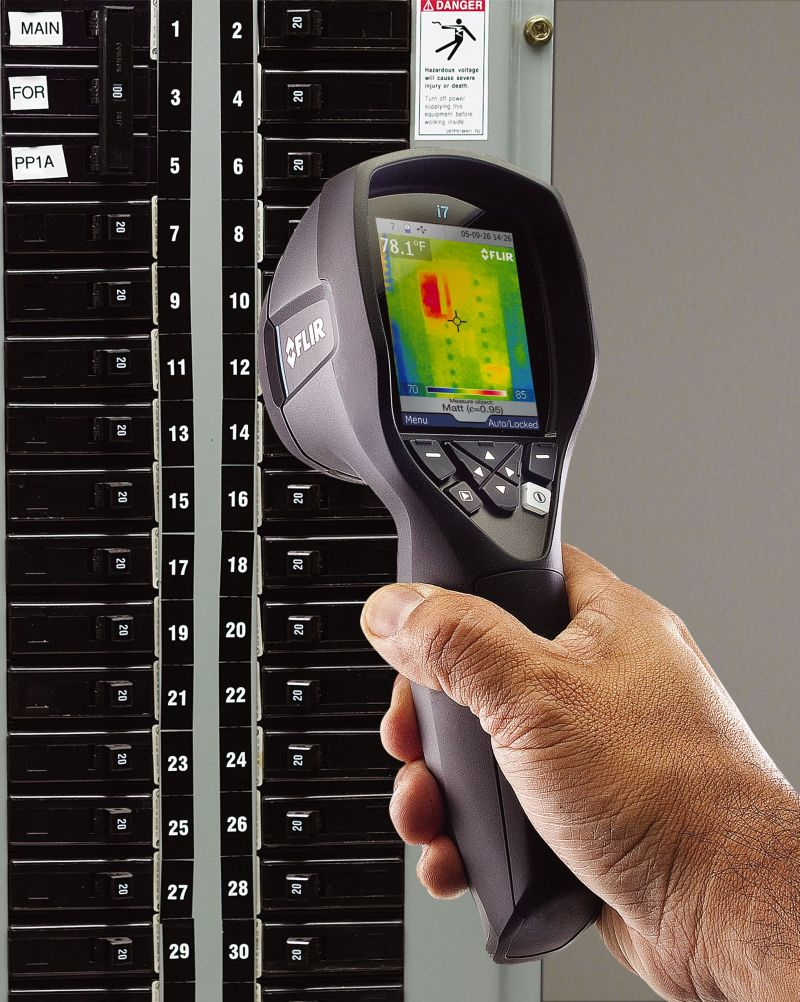 he same level of functionality. And although the three models in the series inherit proven features from their forerunners, their design, build and technical specification are distinctly superior.
Furthermore, the cost of improvement hasn’t been passed on to the end user, FLIR has frozen the price on these entry level models. The new and improved FLIR i3, for example, remains available for just £895 (ex. VAT).
Highly robust
So what’s new? Firstly the FLIR i-Series is much more robust. They withstand a 2m drop test onto a hard surface without any detrimental effect. The reason for this upgrade is the changing profile of the thermal imaging industry. The wide scope of this technology means a thermal imaging camera is in daily use. And in recognition of this FLIR has made its new i-Series eminently fit-for-purpose in harsh industrial and building environments. All models in the range are ingress protection rated to IP43.
Better image quality
The FLIR i5 produces an image of 100 x 100 pixels, an improvement of 56% on the previous generation model. This means it does the job of 10,000 spot measurement meters as its array produces 10,000 individual thermal detection points. As a result it is able to take full image of an area, a component or a structure so that the thermal anomaly can be seen in context. It provides instant information enabling the camera user to see the full extent of the problem.
The FLIR i7 features a 140 x 140 pixel array, providing an increased image quality of 36%. And both the FLIR i5 and i7 also include a wider field of view. This is important as it extends the application scope of these new cameras.
Outstanding ease of use
The new FLIR i-Series models have been designed for entry level users. The fixed, focus-free lens makes it especially quick and easy to apply. Indeed, the basic operation of these cameras can be easily grasped within a few minutes. Thermal images are stored in JPEG format on an SD card or in the camera’s internal memory; all temperature data is automatically embedded in the image. Dependant on the model chosen, the camera comes with analysis tools such as spot meters, areas and isotherms.
New software
All new FLIR i-Series models are bundled with the new FLIR Tools 2.0 software, considered to be the best entry-level product on the market. It allows images to be exported to a PC, analysed and formulated into a basic report with the addition of headers, footers and logos. It also enables filters to be applied when searching for images.
For more advanced reporting functions, the FLIR i-Series can be upgraded to include the latest FLIR Reporter software. Both camera and software technology from FLIR is now highly affordable, a factor that is highlighted by the availability of this new premium software product being available for as little as £134 +VAT.
Naturally these FLIR i-Series cameras are proving highly popular for factory maintenance. They are being used for electrical, mechanical and building inspection and are perfect for any application involving energy management. With every application added to list the return on investment just gets quicker.
Upgrade path
The choice of FLIR camera models has never been greater. There is now a model to suit the needs of a first time user right up to full time consultant thermographer. This is important because as users work with the technology they naturally discover new applications for it.
So, for example, even though you may start with a fixed lens model, the benefits of having interchangeable lenses for various applications will soon become apparent. And the extent of the FLIR product programme enables users to upgrade their cameras in line with their evolving experience and expertise.
Complementing the breadth of choice is the continuous development of various camera grades. A good example is the inclusion of wireless technology in thermal imaging camera design. This provides significant application scope as it allows data from a WiFi enabled moisture meter or clamp meter to be transferred to the corresponding thermal image.
The technology also allows thermal imaging cameras to ‘talk’ to mobile devices such as an iPhone and iPad. The result is far greater application flexibility as it allows images to be shared with colleagues so that swift decisions can be taken on the remedial action needed to prevent loss of production or minimise risk.