
If you haven’t had training for your warehouse job, then how can you do the tasks expected of you?
It’s an consideration when you realise that the HSE Health and Safety at Work Statistics repeatedly places the logistics and storage industry in the top four most dangerous places to work.
A factor that’s not unsurprising when you consider the risks involved – vehicles and automation moving around the space, items falling from height and accidents from incorrect manual handling.
Yet in the warehouse, one training area you might not have considered is your storage equipment. As a leading voice on storage equipment safety within the UK, SEMA understands the risks facing the industry and how racking training can impact the safety of your warehouse.
The warehouse owner’s role in racking safety
While you may think your responsibility for training lies only with employees on the warehouse floor. In reality, as the warehouse owner or manager, you need to check everyone involved throughout your racking’s lifetime is trained – even the teams used by your suppliers.
This isn’t a ‘nice to have’ but goes much deeper by ensuring you are working within the Health & Safety Executive (HSE) and industry regulations.
Trained installers
You might not have considered the importance of installation regarding a strong racking structure, but it’s an essential factor. If the installer has incorrectly installed or missed a crucial step in the racking designer’s specification, it can quickly result in a system not up to the job. With racking potentially holding tonnes of stock, the last thing you want is for any part of that racking to fail due to poor installation methods.
One problem within industry is the lack of racking installation training courses. A lot of installers still learn ‘on the job’ and over time it is very easy for them to pick up bad habits or, even worse, not know the correct methods in the first place. A second complication is that a lot of racking companies subcontract installation work and you can never be sure they have checked their credentials.
One step you can take is to check your installer holds a SEIRS card. Referenced in HSG76 Warehousing and Storage: A Guide to Health & Safety, SEIRS provides a benchmark for the industry by rigorously training installers on correct installation methods in accordance with SEMA standards. An installer who holds a SEIRS Diploma card will have been trained on health and safety installation requirements, practical instruction on correct installation methods and passed a practical assessment to earn their qualification.
Trained warehouse team
Racking training needs to cover far more than working safely in areas with racking. It also needs to cover whether employees understand the Load Notice, correct loading methods, and potential hazards. Yet, there is another factor you need to consider and that is in the everyday safe maintenance and inspection of storage equipment.
 Under PUWER and HSG76 Warehousing and Storage: A Guide to Health & Safety you have a responsibility to inspect your racking – it’s a lot more frequent than you think. Every day ensure employees working in areas with racking can recognise and report if they find damage on the racking. You then need to appoint a member of your team to take on the role of Person Responsible for Racking Safety (PRRS). They will be responsible for racking safety in the warehouse and ensure you meet your legal requirements. You also need a competent member of your team to undertake the visual inspections.
To ensure your employees are racking aware, we suggest they attend training such as our Rack Safety Awareness course. Referenced in HSG76, this one-day course provides them with the advice and knowledge they need to categorise damage found on the racking and responsibilities of users. It will also prepare a members of your team for the role of PRRS and undertaking visual inspections. The course will explain compliance with the law, conducting risk assessments, how often to perform in-house racking inspections and actioning repairs.
Trained racking inspectors
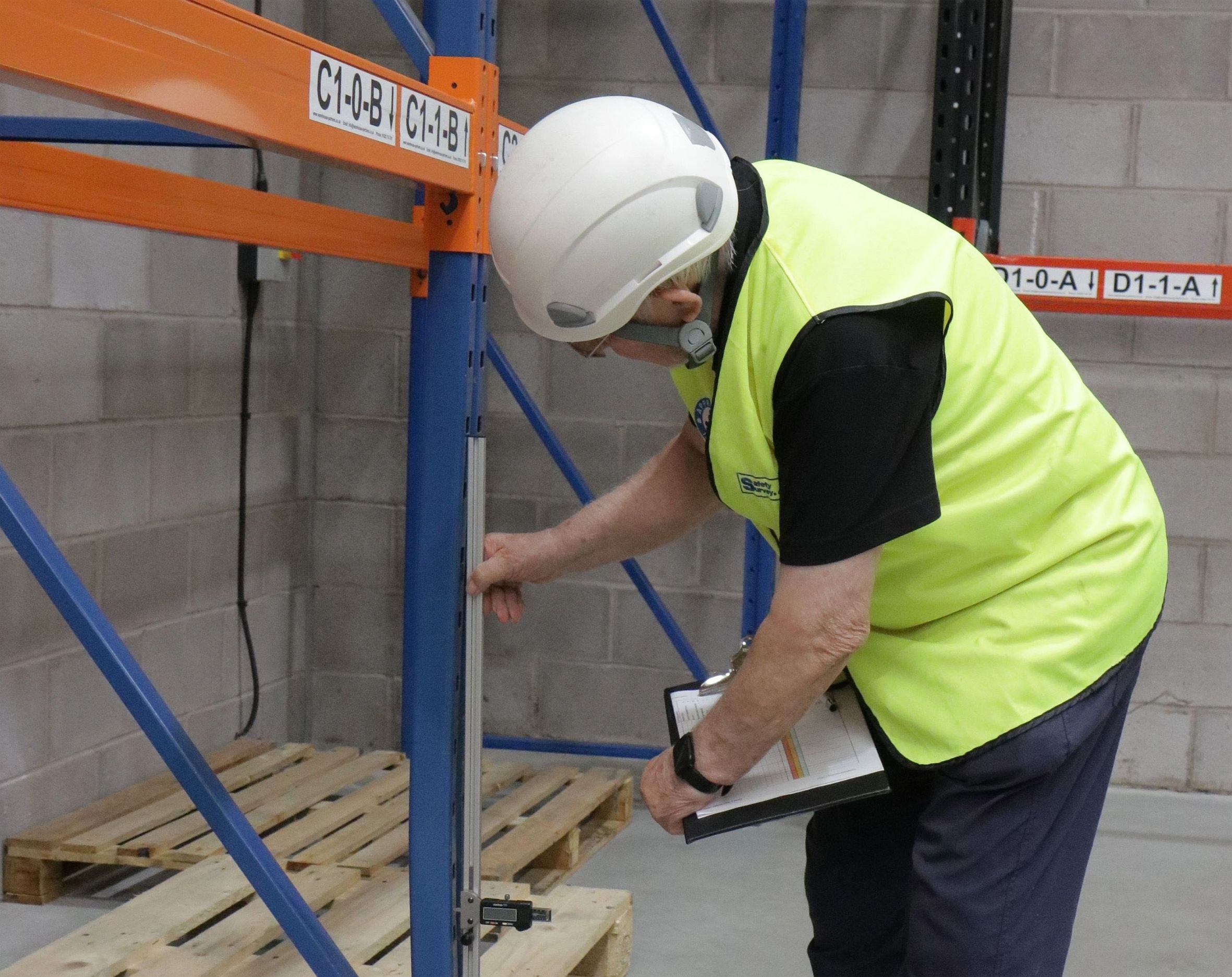
The final stage in the process is your Expert Inspection which should be conducted at least once a year by a qualified professional. While there are lots of rack inspectors on the market, you need to appoint an inspector who has been correctly trained with a high level of engineering expertise.
The SARI initiative was set up by SEMA to raise standard levels in racking inspections. The industry standard “Damage-only” inspections lists damaged items and possibly their location yet an by a SEMA Approved Racking Inspector (SARI) offers far more insight. A SARI doesn’t just note what’s broken – they identify racking type, equipment compatibility, damage, floor fixing suitability and minor issues. Significantly for warehouse owners, their report adopts a traffic-light system, outlining damage levels and timescales for repairs.
The second benefit of using a SARI is the reassurance it offers by knowing the inspector has the engineering knowledge to deliver a high quality and safe inspections. To become a SARI, the inspector must pass an intensive three-day training course and can only earn their qualification once they have completed both a written examination and practical assessment.
SEMA Training
For over 50 years, SEMA has been guiding the storage equipment industry on safe practices within their racking and shelving systems. Central to this are our RoSPA (Royal Society for the Prevention of Accidents) approved courses which cover each stage in the lifetime of your storage equipment.
If you want to show a commitment to safety and would like to sign up for one of our SEMA training courses, visit our website at www.sema.org.uk or get in touch by phoning 01543 278489 or emailing enquiry@sema.org.uk.
To find out more about Racking and Shelving, take a look at Factory and Handling Solutions’ News Page


