
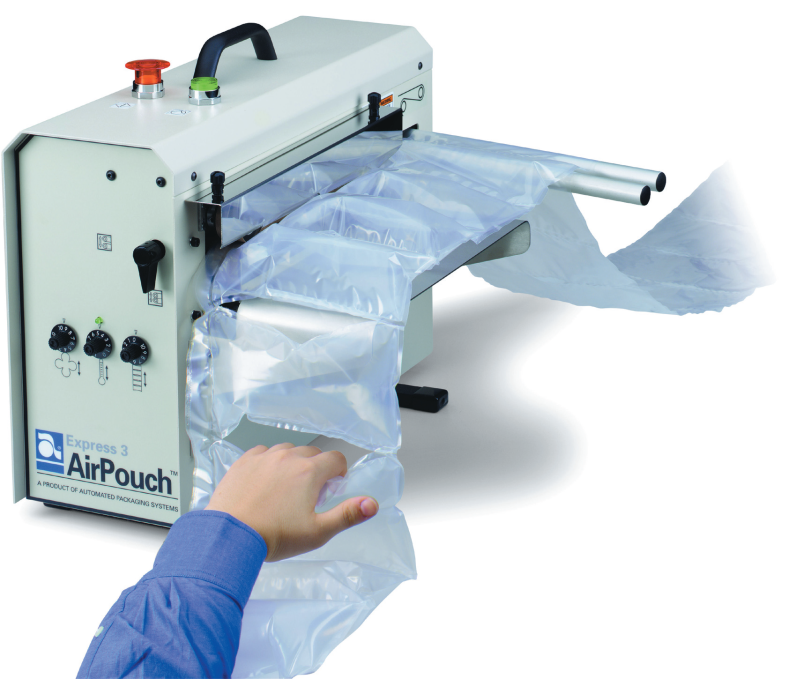
 How many ‘standard’ 200mm inflated air pillows does it take to fill an A4 shipping carton? Contrary to what you might think, the answer isn’t standard’. It depends entirely on the amount of air you put in and the brand of pillow you choose – a decision that could prove costly for you and for the planet
The fillable pocket in a 200mm AirPouch® pillow is 0.5cm wider and 1.5cm taller than its main competitor, for example. That’s 36 more square centimetres of inflatable area in every pillow.
Maximising the final inflated volume of a pillow reduces the number of pillows needed to fill a carton, but it has a vitally important side-benefit too. By increasing the fillable pocket size, AirPouch engineers have reduced the amount of material in seams and skirts, cutting wastage. For every 100 inflated pillows, AirPouch Express 3 utilises 1.3m2 more material in its fillable pockets, material wasted in the seams and skirts of its competitor.
Comparing the actual operating costs of air pillow systems is, therefore, far from straightforward. Cost per pillow needs to take account of pillow volume rather than just the number of pillows per linear metre. It also needs to consider operational efficiency in terms of downtime lost to carton and roll changeovers, and the ease with which operators can tear off the required length of pillows.
On both counts AirPouch scores highly. An AirPouch carton contains 1,500m of material divided into 7,164 individual 200mm pillows, 864 more pillows than can be found on a roll from one of its main competitors.
The AirPouch pillows come fan folded into a carton, substantially increasing the yield over rolled material, cutting downtime lost to changeovers and reducing shipping and storage requirements.
But it is the AirPouch system’s exclusive EZ-Tear™ perforations that make the most significant impact on output capacity. Unlike standard perforations, EZ-Tear makes for an 80 per cent reduction in pull effort required to separate the pillows. The result is faster and more efficient packing and less operator stress and strain.
Relatively little information has been published to date to enable users to compare how brands of pillow perform in transit. However data from laboratory and in-house testing by void-fill experts at Automated Packaging Systems in the United States is helping to shed new light on pillow performance. As well as testing seal quality, they analyse data from Oxygen Transfer Rate and puncture tests to determine film performance and selection.
The company’s XD Blend™ material, currently only available for the AirPouch system in the US, uses the latest in polymer technologies to produce a pillow which stays inflated for longer and which is 80 per cent more puncture resistant (dart).
In common with AirPouch EarthAware pillows – which are available in the UK and Europe – the new XD Blend pillows have been developed for an increasingly environmentally aware market. Automated Packaging Systems converts the film and produces its standard PE and EarthAware™ AirPouch pillows here in the UK rather than import, as some competitors do, from as far a field as China. EarthAware contains at least 90 per cent pre-consumer recycled material and the pillows themselves can be recycled after use.
So how many ‘standard’ 200mm inflated air pillows does it take to fill an A4 shipping carton? The answer is fewer than you think if you choose AirPouch Express 3, the faster, more efficient pillow system with bigger pockets and smaller seams.
Automated Packaging Systems
T: 01684 891400


