Health and safety is an important part of any business, but in industrial environments, where vehicles, machinery, stock and people are all required to move safely through the same area, it’s essential
However, as operations grow and become busier, keeping sites safe and organised can become increasingly difficult.
One reason is a lack of space. In fact, almost a third (29 per cent) of warehousing professionals report space constraints as a major operational challenge. As storage expands and workflows overlap, facilities can become more congested, increasing the likelihood of reduced visibility, blocked access routes and conflict between vehicles, pedestrians and stock. That’s why more businesses are looking at how better use of space can help create safer, more organised working environments.
When space becomes a safety issue
Space rarely disappears overnight. What usually happens is operations expand gradually, and storage, production and dispatch begin to compete for the same space. Then, storage starts to overflow into working areas, loading zones get busier and segregation becomes harder to maintain consistently, all of which makes sites harder to organise safely and efficiently.
As this is happening, so the potential for problems increases. Accidents are more likely to occur when pedestrians share space with vehicles and machinery, 12 per cent of non-fatal injuries are caused by contact with moving machinery, and as stock spills out of store rooms, housekeeping becomes more difficult, leading to more trips and falls.
Issues can also arise if storage areas aren’t properly set up to contain hazardous materials, or if stock or equipment blocks access routes, emergency exits or working areas. Even relatively small changes to the layout or storage capacity can affect the day-to-day management of the site and its safety.
Creating separation between workflows
One of the simplest ways to improve safety on site is to create clearer separation between different activities. Temporary buildings can help with this by creating dedicated areas for specific parts of the operation.
Overflow stock can be moved out of production areas, dispatch activity separated from warehousing, or loading and packing areas repositioned away from main vehicle routes. In some cases, businesses also use temporary buildings to create dedicated quarantine, returns or maintenance areas, helping prevent operational activity from spilling into spaces not designed to handle it safely. This not only improves organisation but also reduces unnecessary interaction between people, machinery and moving vehicles.
Visibility improves, bottlenecks are reduced and loading and unloading become easier to manage. Wider access routes and clear-span structures also allow layouts to be arranged more effectively around racking, equipment and storage requirements.
Adding space without disrupting the site
The challenge for many businesses is creating additional space quickly enough to relieve pressure on existing facilities before safety or efficiency begin to suffer. Permanent extensions can involve lengthy planning, significant groundworks and disruption to existing operations, making it difficult to respond quickly when requirements change.
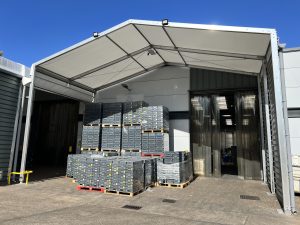
Temporary buildings offer a more practical alternative. PVC roof structures, in particular, can be installed directly onto existing surfaces without the need for pre-prepared foundations, allowing additional space to be created quickly and with minimal disruption. Buildings can often be installed and operational within weeks, helping businesses respond faster to changing requirements.
At Smart-Space, rental options also allow businesses to add space without committing to a building long-term, making it easier to introduce additional capacity even when future needs remain uncertain.
Because buildings can be located around the available site space, they can also help businesses make better use of awkward or underused areas that might otherwise be difficult to develop. Large access openings and flexible positioning help buildings integrate into existing operations without creating additional pinch points or restricting movement around the site.
A safer site is often a more efficient one
As industrial operations grow, sites can quickly become harder to manage safely and efficiently. What often starts as a lack of storage space can gradually affect visibility, organisation and the day-to-day running of the site as a whole.
Creating additional space helps relieve that pressure, giving businesses more room to organise stock, separate activities and keep operations running smoothly. Temporary buildings provide a practical way to achieve that quickly, helping businesses adapt to changing demands while creating safer, more manageable working environments.
For more information, visit www.smart-space.co.uk
Visit our NEWS page for more industry updates