Tekpak Automation doubles throughput for medtech firm while reducing labour, footprint and packaging logistics
When a multinational biopharmaceutical manufacturer approached Tekpak Automation, the initial requirement appeared straightforward: automate the closing of pre-made cartons containing pre-filled syringes. But with production demand increasing, limited cleanroom space and a challenging 12-14 month lead-time requirement, the project quickly evolved into something much more ambitious.
Tekpak developed a fully automatic top-load cartoning system incorporating AI-enhanced machine vision, precision robotic handling and automated carton and insert forming. The result is a compact, highly integrated packaging solution that has more than doubled production capacity, increasing output from a maximum of 12 devices per minute to 25 single-device packs p/m (or 50 devices p/m in double packs). At the same time, the number of operators required on the line has been reduced from six to 1.5, while the customer has also brought carton forming in-house, reducing transport costs and packaging waste.
From a simple requirement to a complete automated solution
A longstanding Tekpak client since 2015, the customer’s original brief for this project – packaging pre-filled syringes for the global biopharmaceutical market – was deliberately narrow.
Pre-made cartons were being shipped from mainland Europe to the company’s Irish facility, where they were manually inspected, loaded with the product and leaflet, and glue-closed.
Initially, the customer simply wanted Tekpak to automate the carton-closing operation. As discussions progressed, however, the scope expanded.
Frankie Rose, Technical Sales Manager for Tekpak Automation, explains: “The conversation moved from closing the cartons, to loading them, then to forming the cartons themselves. Inserts were subsequently brought into the automation project, too. What began as a carton-closing application therefore evolved into a fully automatic packaging system, integrating carton forming, complex insert handling, product inspection, robotic loading, leaflet insertion, carton closing and final verification.”
Designed around a challenging footprint
One of the project’s biggest constraints was physical space. The existing production line incorporated serialisation equipment at its downstream end. Relocating this equipment was not a viable option because doing so would have required the customer to revalidate the entire serialisation process. The new packaging system therefore had to fit into the existing production environment without moving the serialisation equipment. This made footprint a critical design consideration from the outset.
Tekpak’s modular approach to machine design enabled the system to be configured around the available space, rather than requiring the customer to redesign its production area around the machine. The result was a compact automated system capable of delivering substantially greater production capacity, without requiring changes to the downstream serialisation process.
Meeting a demanding lead time
Lead time was another major consideration. Increasing order volumes meant that the manufacturer needed additional packaging capacity quickly, with a target project delivery timeframe of approximately 12-14 months.
The modular design of Tekpak’s technology was again instrumental in meeting this requirement. Rather than relying on a large, inflexible machine, Tekpak was able to develop the solution around a series of integrated modules, allowing the system to be engineered specifically to the customer’s requirements while maintaining the required project schedule.
“This combination of compact design, modular technology and application-specific engineering helped us deliver a solution that our competitors could not match within the customer’s required timeframe,” states Frankie.
Handling randomly orientated pre-filled syringes
Automating the handling of the pre-filled syringes presented another significant challenge.
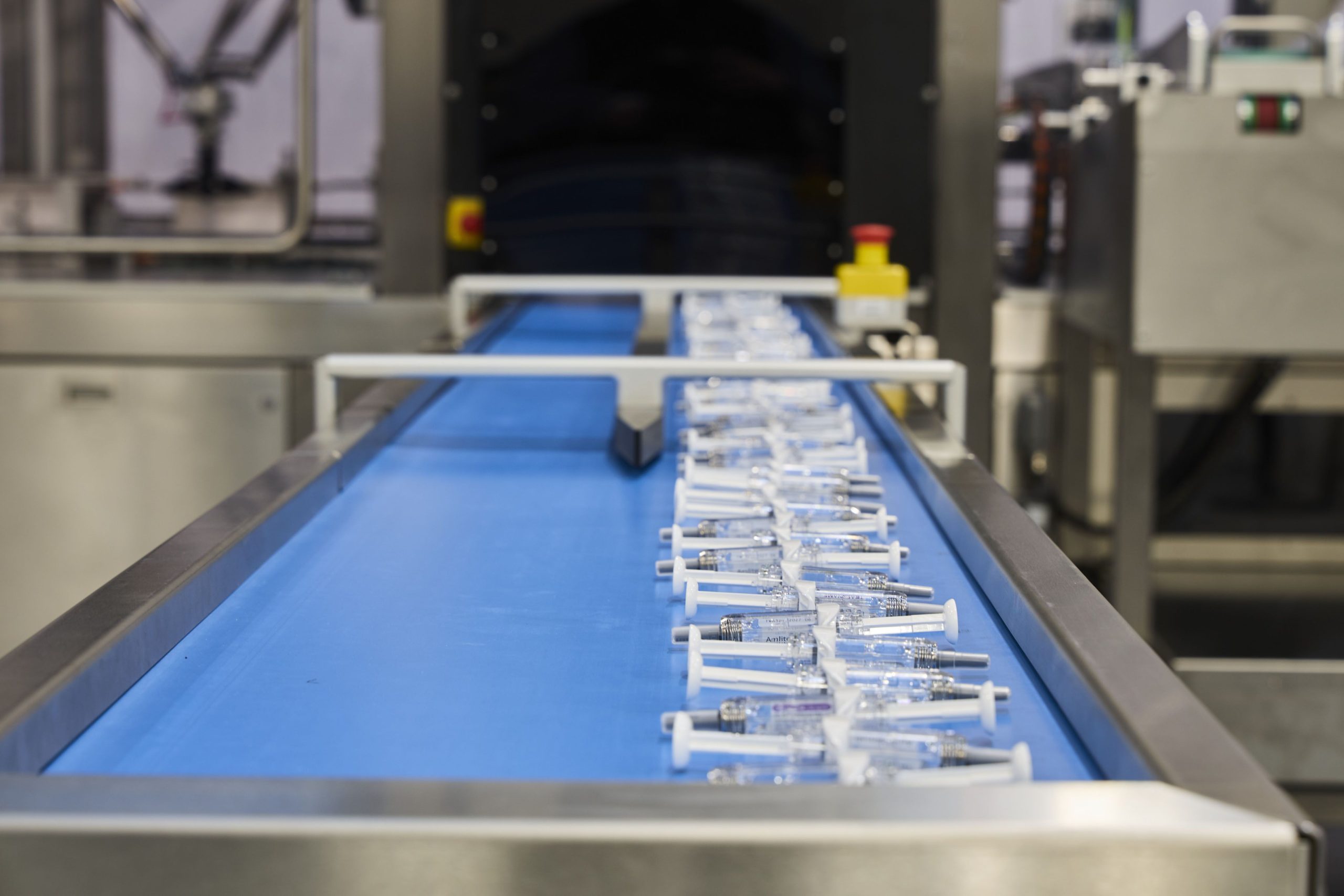
The devices arrive on the conveyor with small variations in both position and orientation. For a conventional pick-and-place system, this variability can make accurate robotic handling difficult. However, Tekpak addressed this using AI-enhanced machine vision.
“As each syringe enters the system, the vision technology identifies its position and orientation on the conveyor,” explains Frankie. “This information is then used to synchronise the robot’s movement with the individual device. The robot can accurately pick each syringe regardless of its orientation on the incoming conveyor and place it correctly into the packaging process. This eliminates the need for operators to manually orientate the products before loading, while maintaining the speed and accuracy required for automated production.”
A fully integrated top-load cartoning system
At the heart of Tekpak’s solution is a fully automatic top-load cartoner comprising 19 stations.
The carton itself is produced from a flat blank, allowing the customer to receive and store unformed cartons rather than importing pre-formed packaging. The inserts, however, presented an additional engineering challenge due to their complex geometry, effectively forming an almost negative profile of the pre-filled syringe. As a result, six stations within the machine are dedicated specifically to folding, gluing and placing the inserts.
Once the insert has been assembled and attached to the carton base, a combination of probe sensors and AI-enabled vision technology then verify the completed carton. Any item that fails the inspection is automatically rejected, while approved cartons continue through the process.
At the same time as the carton and insert are being prepared, the pre-filled syringes enter the machine in parallel. The vision system performs various checks on each device before it is picked, including verifying its orientation and key characteristics such as plunger length and skew angle. The robot then picks the verified device and loads it into the carton, before inserting the appropriate leaflet.
Once the product and leaflet are inside, a vision verification is performed confirming a complete carton. The carton is then closed and sealed via a specifically positioned glue bead before being discharged from the machine.
Continuous verification
As part of the project, quality control has been built into the system, rather than being treated as a final-stage inspection. At each stage, the inspection process checks elements including:
- Correct pharmaceutical code on the: Carton, Insert and IFU/leaflet
- Correct pre-filled syringe
- Product orientation
- Correct syringe assembly
- Plunger position
- Insert assembly
- Carton integrity
This means that both product and packaging are continuously verified as they progress through the system. AI-enhanced vision technology plays a central role, relaying the information required to make decisions about whether individual components and completed assemblies should proceed or be rejected.
More than twice the productivity
Tekpak’s automated top-loader cartoning system has transformed the customer’s packaging operation. “Previously, the manual process required six operators and was capable of packing a maximum of approximately 12 devices per minute,” explains Frankie. “It can now produce more than double this amount – 25 single-device packs per minute or 50 devices per minute in double packs – with just 1.5 people. Existing operators have been relocated elsewhere within the business or upskilled to support the operation of the new automated line.”
However, the benefits extend far beyond the packaging line itself. Previously, the customer was importing pre-formed cartons from mainland Europe, but as the new system can form cartons automatically from flat blanks, they can now source and handle carton and insert flat blanks locally.
This has reduced the costs and logistics associated with transporting bulky pre-formed cartons from Europe to Ireland, as well as delivering sustainability benefits. Flat blanks require less space to transport, while producing the cartons in-house reduces the amount of miles travelled, as well as the volume of packaging and unboxing waste associated with receiving pre-formed cartons.
The success of the project has strengthened an already longstanding relationship between Tekpak and the pharmaceutical manufacturer, with a second order already in place for a similar automated system to handle auto-injectables.
Engineered around the customer
For Tekpak, this project demonstrates the value of taking a holistic approach to packaging automation. “By working collaboratively with the customer, we identified an opportunity to automate the complete packaging process – from flat carton blank and complex insert assembly through to product inspection, robotic loading, leaflet insertion, final verification and integration with downstream serialisation,” says Frankie Rose.
“The result is a compact, high-speed packaging system that has more than doubled throughput, reduced labour requirements, eliminated the need to import pre-formed cartons and fitted into an existing production environment without relocating critical serialisation equipment.”
For more information, visit https://tekpakautomation.com/
Visit our NEWS page for more industry updates