An FHS interview with Adem Kulauzovic, Director of Automation and Integration, Domino Printing Sciences
- Domino Printing Sciences has a long history of innovation in industrial coding and marking. What are the biggest changes you’ve seen in manufacturers’ requirements over the past five years, and how has Domino adapted to meet those evolving needs?
One of the biggest changes we’ve seen is the growing demand for automation and integration on manufacturing lines. More manufacturers are moving towards automated production environments, not necessarily as a cost-cutting exercise, but because it’s increasingly difficult to find production line operators. Automated systems are becoming more popular as a way for manufacturers to maintain productivity despite these challenges.

The growth in automation means that coding and marking systems are no longer considered or expected to be standalone devices. Manufacturers are increasingly looking for systems that will integrate with existing automation infrastructure and communicate with wider production systems. The ability to exchange information across the production line has become a key requirement.
Manufacturers are also becoming more aware of the value of production data from integrated systems, and coding and marking solutions are a key part of this. These systems aren’t just there to apply codes to products; they can also provide valuable information on line performance, throughput and efficiency. As a result, manufacturers are increasingly looking for solutions that integrate with centralised SCADA and MES systems to gain a clearer view of overall production performance.
Domino has adapted quickly to these changing requirements by partnering with leading automation providers and adopting industry-standard communication protocols, enabling our systems to integrate with other machinery on the line. Our support for standards such as PackML and OPC UA enables communication with a wide range of PLCs and control systems, helping customers build connected production environments. We’ve also expanded our software capabilities: solutions such as Domino Cloud allow customers to gather, analyse and share production data through a common platform.
- Many manufacturers are looking to increase productivity while reducing waste. How do modern coding and marking technologies contribute to improving efficiency, quality control and sustainability on the factory floor?
Over the past decade, production has become far more complex. Gone are the days of long runs of a single mass-produced product; manufacturers now need to manage a growing number of SKUs, shorter production runs and faster turnaround times. Many production lines that once completed just one or two product changeovers per day may now handle eight to ten. Every changeover introduces the potential for delays, coding errors, product waste and lost productivity, making efficient line management more critical than ever.
Modern coding and marking technologies help address this by simplifying operations and reducing the potential for operator errors. Systems are intuitive, highly graphical and require fewer manual interactions than previous generations of equipment. Maintenance is also significantly easier, quicker, and more predictable, standard maintenance tasks that may have previously required regular unplanned downtime are typically quicker, fewer, and further between. Tasks can also typically be preplanned or completed during production, further reducing disruption.
Coding automation also plays an important role in improving productivity by reducing manual data entry and streamlining product changeovers. Coding systems can communicate with PLCs, SCADA platforms and ERP systems to access code data and automatically move from one product run to the next. Manufacturers can even create automatic alerts that prompt operators to prepare for the next production run, reducing the time required to move from product A to product B.
Vision systems are also lending a hand, with automated code verification playing a key role in reducing waste from incorrectly coded products. Rather than relying solely on periodic manual inspections, manufacturers can now verify codes continuously. A line equipped with a simple ‘code and check’ vision system can reject substandard products and provide automatic alerts to prompt intervention where a wider issue could be affecting code quality. Crucially, this can be done automatically within a few products, preventing a build-up of incorrectly coded products and subsequent waste.
- As factories become more connected through Industry 4.0 and smart manufacturing initiatives, what role do coding and marking systems play in providing traceability, data integration and real-time production insights?
Coding and marking systems are an essential component of modern traceability strategies. Manufacturers today face increasing regulatory and consumer demand for transparent information on the origin of products and ingredients, and how they moved through the supply chain. A machine-readable code on the product is the only practical way to provide this information.
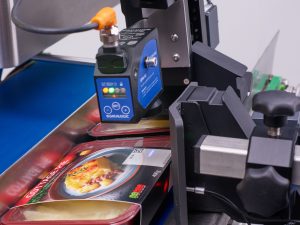
Coding and marking systems are a key part of the puzzle, providing the means to apply this unique information to each product and the data required to track individual products throughout manufacturing, warehousing, distribution, and ultimately to the consumer. Without a 2D code or other advanced data carrier, effective traceability is not possible.
Automated coding and marking equipment, in conjunction with machine vision systems, can also provide manufacturers with real-time production insights by logging items coded and rejected across different lines, shifts and days. Most manufacturers understand the theoretical maximum output of their production lines but often struggle to identify why actual output falls below this figure. These insights can provide an important piece of the overall production picture and help manufacturers understand why lines may be operating below their full potential. By sharing operational data with connected systems, manufacturers can gain visibility into line performance and identify inefficiencies and bottlenecks.
- What are the most common challenges manufacturers face when implementing new coding and marking solutions, and what advice would you give to businesses looking to modernise their production lines with minimal disruption?
One of the biggest challenges that manufacturers face is trying to do everything themselves. Too often, coding and marking systems and solutions are treated as a simple equipment purchase, with the manufacturer expecting to handle the integration and optimisation internally. This can be disruptive and simply isn’t necessary.
Decisions regarding installation, integration, automation and data sharing can significantly impact production efficiency and visibility across the factory floor. So, my advice is to look for a partner, not just a supplier. Companies like Domino bring decades of experience across multiple industries and can help determine where equipment should be installed and how it should be integrated, as well as provide turnkey solutions to improve operational performance.
Manufacturers should look for suppliers that are willing to be part of the journey, supporting installation, configuration and integration while helping deliver the outcomes the business is looking to achieve. A collaborative approach reduces risk, speeds up implementation and allows manufacturers to maximise the value of their investment.
- Looking ahead, what emerging technologies or industry trends do you believe will have the greatest impact on industrial printing, coding and product traceability over the next five to ten years, and how is Domino preparing for that future?
Manufacturing itself is already becoming more flexible and modular. Rather than operating dedicated lines for specific product formats, manufacturers increasingly want production systems that can handle a broader range of products. We’re also seeing the emergence of smaller, strategically located micro-factories positioned closer to distribution centres to support evolving fulfilment models. These changes will require coding and marking technologies to become more versatile, capable of operating across a wider range of products, substrates and applications.

The biggest trend will be the continued expansion of end-to-end traceability via on-product 2D codes. Today, traceability is often limited to cases, pallets, or selected high-value products. In the future, manufacturers will increasingly require complete aggregation, linking individual items through cases and pallets and across the entire supply chain. New standards, such as GS1 Digital Link, and regulatory changes such as digital product passports, will further increase the amount of information available throughout a product’s journey.
In line with this, vision systems will become increasingly important as manufacturers seek to verify that every code is readable and traceable. A product that cannot be scanned creates supply chain inefficiencies and potential financial penalties, making verification a critical component of future production lines.
Today, industrial coding and marking is about so much more than just putting ink on a package; it’s about turning every product into a data asset. This evolution is set to continue over the next five to ten years, with increasing demand for more on-product data from everyone involved in global supply chains. Domino is focused on evolving our solutions to support this change by providing advanced variable data printing expertise and verification capabilities that customers need to enable traceability, connectivity and smarter decision-making throughout the supply chain.
For more information, visit www.domino-printing.com